
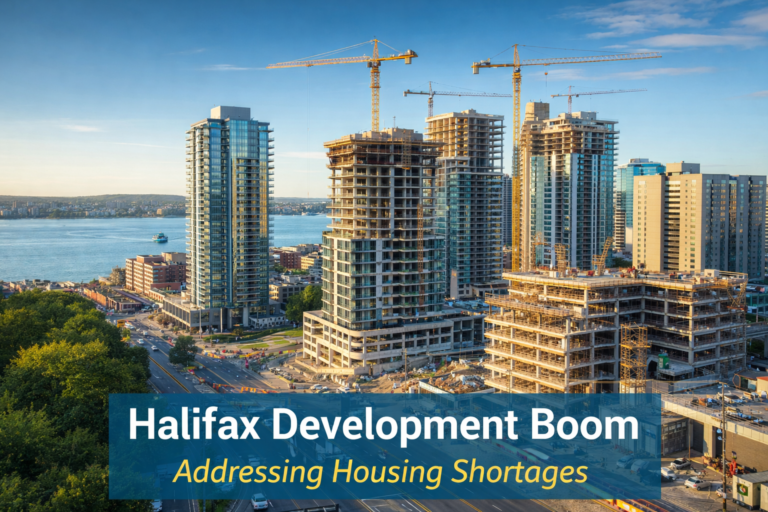
Halifax’s housing shortage isn’t news to anyone living in the city. The numbers have been reported widely, debated at council, and felt directly by renters, students, and families trying to find stable, affordable places to live. But as construction ramps up across the municipality, the conversation is starting to shift from “how much” to “what kind.”
The numbers behind the shortage
A provincial housing assessment, conducted by Turner Drake & Partners and reported by CBC Nova Scotia, found that Halifax has an estimated shortfall of 17,500 units. The same report warned that if construction doesn’t accelerate, that gap could grow to over 31,000 units by 2027.
On the demand side, Halifax surpassed 503,000 residents in 2024 and continues to attract newcomers. The city welcomed over 10,000 immigrants in 2023–24 alone, more than double the figure from a decade earlier. International students, interprovincial migrants, and returning Nova Scotians are all contributing to population growth that has outpaced housing supply for several years running.
On the cost side, the average two-bedroom apartment rent in Halifax reached $1,707 in 2024, and the average residential sale price rose to $600,008 in 2025 — a 4.1% year-over-year increase. Apartments renting below $1,300 per month had vacancy rates under 1%, meaning affordable stock is essentially non-existent for many renters.
Construction is responding — but it’s complicated
The good news: Halifax’s construction sector has been ramping up. Housing starts were up 32% through the first 10 months of 2025 compared to the prior year, according to CBC reporting on CMHC data. More than 13,000 units were under construction as of October 2025, and rental starts in Halifax hit record highs.
CMHC’s Spring 2026 Housing Supply Report confirmed that rental construction drove overall new housing supply nationally in 2025, with rental units under construction nearly doubling the 10-year average across major Canadian markets. Halifax was among the cities that saw record rental starts.
The municipality has also been working on the regulatory side. Through the federal Housing Accelerator Fund, Halifax received $79.3 million to support initiatives aimed at creating over 15,000 new housing units between 2023 and 2026. Zoning changes adopted in 2024 increased allowable building heights and unit density in key zones, and the city created regulatory capacity for up to 200,000 additional units in the Urban Service Area.
But construction volume alone doesn’t solve everything. About 81% of Halifax’s housing starts are aimed at the rental market, which addresses one pressure point. However, CMHC’s 2026 Housing Market Outlook noted that Canada’s continued reliance on apartment development, combined with elevated construction costs, has limited the expansion of family-sized ownership housing — a segment that continues to face structural supply shortages.
The “missing middle” question
One area that keeps coming up in housing discussions is the need for “missing middle” housing — duplexes, triplexes, townhouses, and small-scale multi-unit buildings that sit between single-family homes and high-rise towers. These are often faster and cheaper to build than large apartment complexes, and they can add density to existing neighborhoods without dramatically changing their character.
Halifax’s HAF-related zoning reforms have started to open doors for this kind of development, with amendments allowing more gentle density in serviced residential areas. CMHC’s 2026 supply report noted that missing middle starts rose about 10% nationally across major markets in 2025.
This is the space where smaller developers and design-build firms tend to operate. Matthew Oldford, founder of the Halifax-based firm Matty’s Renos, is one example. His early work involved converting existing properties — turning duplexes into triplexes, adding secondary units, and working through the permitting process on complex residential conversions in areas like Dartmouth. That kind of incremental, property-level development is exactly what the missing middle concept describes.
Oldford has since expanded into larger multi-unit development and purpose-built student housing in Halifax’s South End. But the progression from small-scale conversions to larger projects reflects a path that’s available to other builders and investors in the market — particularly those willing to navigate the permitting and regulatory landscape.
Student housing as a specific gap
Student housing has emerged as its own category of need in Halifax. The province has pushed universities to provide housing beds for at least 15% of full-time students or demonstrate credible plans to reach that threshold. Dalhousie University sits just under 14% and needs roughly 188 new beds. NSCAD currently provides zero student housing beds. Cape Breton University is at approximately 5%.
Meanwhile, students are competing in a rental market where one-bedroom apartments average around $2,030 per month. Fixed-term lease structures have allowed some landlords to reset rents by cycling tenants, even with Nova Scotia’s rent cap in place (extended through the end of 2027).
Purpose-built student housing — designed from the ground up for that specific use, with walkable campus locations and layouts suited to student life — is a different product than converted apartments. Several developers in Halifax, including Oldford, have identified this as an area where demand clearly outpaces supply.
What comes next
RE/MAX’s 2026 Halifax outlook projects a 3% increase in average residential sale prices and a 2% rise in sales activity. The market is expected to transition toward a more balanced state as consumer confidence returns and new supply is absorbed. Dartmouth, Sackville, and Bedford West are flagged as the most desirable neighborhoods heading into 2026.
On the rental side, there are early signs of the new supply having an effect. Industry observers have noted that asking rents on some new buildings have started to come down slightly, and more apartments are offering move-in incentives. But the affordable end of the rental market remains extremely tight, with vacancy rates for lower-cost units still near zero.
The challenge going forward isn’t just building more — it’s building the right mix. Halifax needs rental stock, student accommodations, missing middle housing, and family-sized ownership units. No single project type addresses all of those needs. The developers, builders, and policymakers who recognize that complexity are the ones most likely to contribute meaningfully to closing the gap.
Sources:
• CMHC Spring 2026 Housing Supply Report
• CMHC 2026 Housing Market Outlook
• CBC Nova Scotia — Halifax housing starts up 32% (Dec. 2025)